
The corridor running from Bessemer out through McCalla toward Tannehill has been busy for years now. Residential development off Eastern Valley Road and Mount Olive Road, commercial and distribution space near the interstate junctions, and steady renovation work on the older housing closer to town.
For a contractor, waste handling on those sites is not a line item you think about until it stops the job. Then it is the only thing you think about.
Match the container to the phase, not the project
The mistake we see most often is one container ordered at the start and left in place until the punch list. Debris volume is not constant across a build, and neither is the type of material.
Demolition and site prep. Highest volume, heaviest material. Concrete, masonry, and dirt need a 15-yard container because they hit haul weight fast. Mixed demolition debris that includes framing and finishes can go in a larger box.
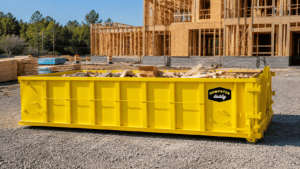
Framing. High volume, low weight. Cutoffs, banding, packaging, sheathing scrap. This is where a 30-yard or 40-yard earns its keep, because the material is bulky and light.
Mechanical, electrical, and plumbing rough-in. Lower volume, but constant. Duct scrap, conduit, boxes, packaging. A 20-yard on a longer cycle usually covers it.
Drywall and finishes. Volume climbs again. Drywall scrap, flooring offcuts, cabinet packaging, paint buckets that are empty and dry. A 25-yard fits most of this.
Punch and final clean. One last container, usually a 20-yard, timed to the week before turnover.
Planning swaps against that schedule is cheaper than one oversized container sitting half empty for four months.
Place it once, place it right
On a jobsite the container gets moved by whoever needs it moved, which usually means it ends up somewhere the truck cannot reach.
Set the drop location before the pad is poured or the drive is cut, and keep an approach open for the truck through the whole build. A roll-off truck needs a firm surface, about 12 feet of width, roughly 60 feet of straight approach to back in, and 20 feet of overhead clearance.
On a McCalla lot with soft ground after a wet week, the approach matters more than the location. A truck that sinks is a truck that is not on your next site either.
Swap scheduling that does not cost you a day
Call the swap before the container is full, not after. A container that is already overflowing means the crew has been throwing debris on the ground for a day already, and now you are paying someone to pick it back up.
The practical rule: when the load reaches about three quarters, call it in. That gives the schedule room to work and you never have a stopped crew.
For sites running long, a standing rotation is easier than ad hoc calls. Tell us your framing start date and we will build the schedule around it.
Keep the site inspection ready
Debris management shows up in more than just efficiency.
An inspector walking a site with clear paths, contained waste, and no nail-strewn ground forms a different opinion than one climbing over piles. So does a client walking a job before closeout, and so does a superintendent doing a safety walk.
A few habits that pay for themselves:
Keep the container within throwing distance of active work, or crews will stack debris where they stand
Load flat and level with the top rail so pickups never bounce
Keep hazardous material out of the box entirely, since one contaminated load can cost more than a week of service
Sweep the container pad at the end of each week
What cannot go in a construction container
Paint that is still liquid, solvents, adhesives that have not cured, fuel, oil, batteries, tires, asbestos-containing material, and refrigerant-bearing units all have to be handled separately. Asbestos in particular has its own regulatory track and it is not something to guess at on an older Bessemer teardown.
If you are unsure what a material counts as, ask before the load leaves. It is a much shorter conversation than a rejected load.
Contractors working the southwest metro
Dumpster Daddy runs jobsite service throughout Bessemer, McCalla, Hueytown, Pleasant Grove, Hoover, Alabaster, and the rest of the Birmingham metro. No long-term contracts, straightforward pricing, and a direct contact rather than a dispatch queue.
See our construction dumpster rental service or call 205-447-8044 to set up a schedule for your next build.